Warped blind
The move-in photo records the state the blind was in. The move-out photo records how you left it. Between the two there is a documented change and two dates that do not depend on your word.


Deposit dispute
The day you hand back the keys, your word is worth the same as your landlord’s. A photo sealed with a date the day you moved in is not.
Private. Only the file fingerprint is registered.
Damage verification in practice: the same room on move-in day and on move-out day. Enlarge the images to see how the comparison holds up when each photo has its own sealed date. All three are an illustrative example — they are not certificates from real customers.
The move-in photo records the state the blind was in. The move-out photo records how you left it. Between the two there is a documented change and two dates that do not depend on your word.
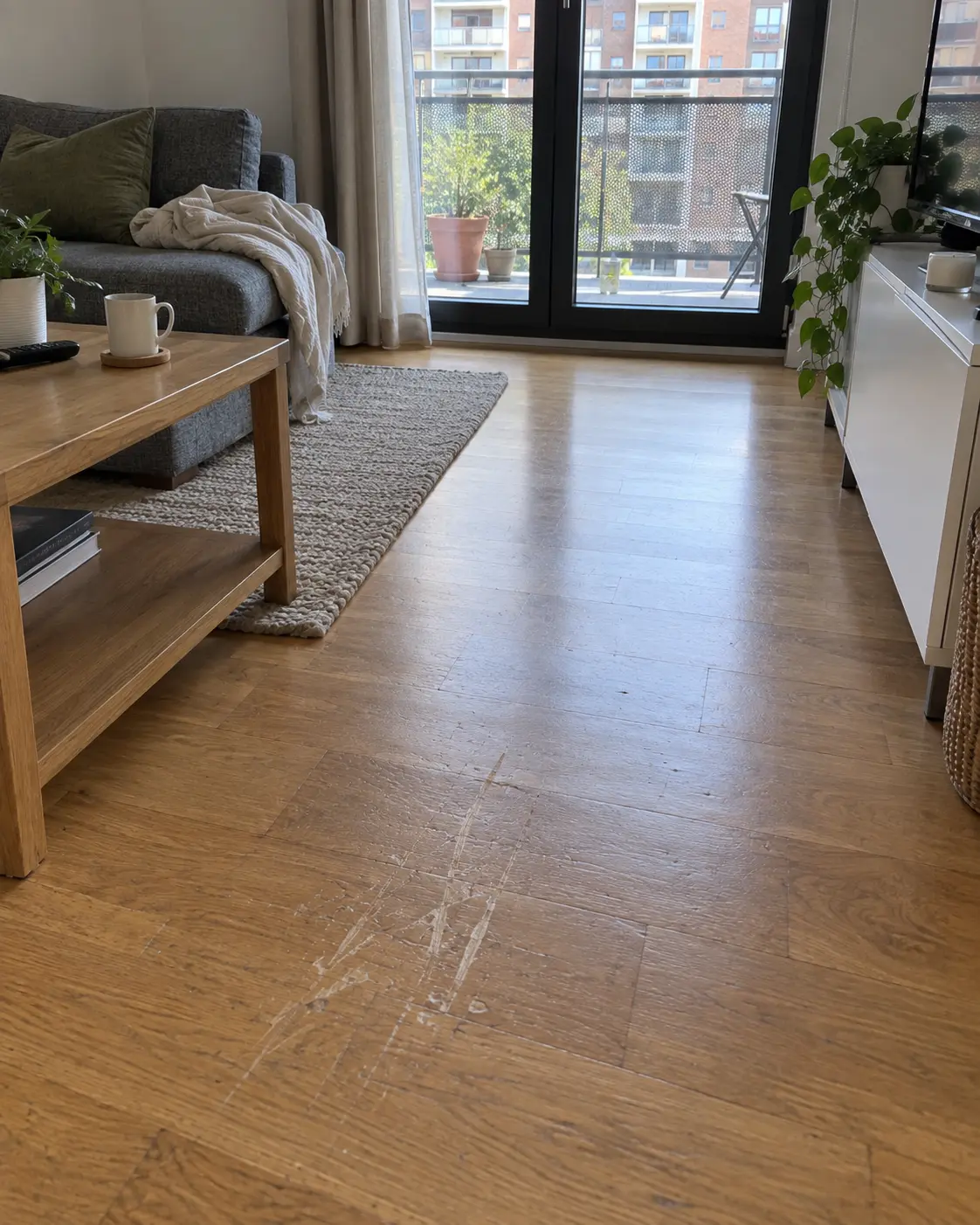
A wide shot in daylight records the whole surface. If a scratch is not in the move-in photo, you have a record of how the floor was that day; when and how it appeared is still an argument, but now with a dated reference on the table.
Photographing the items that usually get disputed up close (mirrors, taps, tiles, appliances) keeps the detail from being lost in the wide shot.
The scene
Last day. Boxes in the hallway and the flat empty for the first time in two years. The landlord walks through the rooms in silence and stops in the living room. They point at the parquet by the window. “You did this.” You know that mark was there the day you moved in. You remember because you noticed it. But you didn’t take a photo, or you took one on your phone and now you don’t know which folder it is in or when it really dates from. “I’ll take it off the deposit. If you don’t agree, you can make a claim.” Word against word. And they have the deposit.
Only need to fix the date of a few photos, without an inventory? How to certify a photo with a date and time →
Sellat does not decide who caused a defect, what it costs to repair or how much of the deposit you should get back. That is for an agreement, an arbitrator or a judge. Sellat proves one concrete thing: that those exact photos and that exact inventory existed on the date you sealed them, and that nobody has touched them since. It is technical evidence about an exact version of a file. With it, “it was already like this” stops being just your word.
The whole circuit
One concrete case: you move into a rented flat, photograph the state it is handed to you in, and when you leave your deposit is withheld for damage that was already there. This is what happens in between. The circuit is the same for a contract, a report or a record from your system: the file changes, the steps do not.
Day 0
The day you pick up the keys you photograph the blind, the floor and the rest of the flat. For now it is one more photo on your phone, carrying whatever date your phone says.
Day 0, two minutes later
You drag the photos into Sellat. Your browser computes each file fingerprint and only that fingerprint is sent. Add the qualified seal and the date comes from a timestamping authority, not from your phone and not from us.
Day 0, in your inbox
The PDF certificate and the full package arrive as a ZIP. You store it next to the tenancy agreement and forget about it. No account and no subscription are needed to keep it.
Two years later
Your deposit is withheld over the blind. You open the ZIP: inside is the exact photo you took on day one, its fingerprint and the sealed date, with checking instructions in Spanish and English.
The same day
You pass that ZIP to your lawyer, to an expert witness or to the insurer. Any of them can check the date and that the file is untouched without asking us for anything and without taking your word or ours.
Sellat does not decide who caused the damage, what it costs to repair or how much deposit you get back. A settlement, an arbitrator or a judge decides that. What the package adds is a date that does not depend on you.
Seal my photosWhen you send a photo through WhatsApp or Telegram, the app re-compresses it so it weighs less. The image that arrives is no longer the file you made: different bytes, and therefore a different fingerprint. If all you kept is the copy that went through the chat you can still seal that, but you will be sealing the copy and not the original. The right move is to seal the photo as it comes off the camera, and send it afterwards.
When you seal, you receive the PDF certificate and your proof package by email. That package is what you show when the dispute arrives: inside it is the exact file that was sealed, its fingerprint, the date and the instructions for anyone to check it without trusting you or Sellat. In the normal flow Sellat does not keep your original after the proof is created, so keep that package yourself, next to the tenancy agreement — or turn on custody, optional and free with an account, so Sellat keeps the original too.
Nobody argues about the date on a registered letter, because a third party puts it there. Phone photos are the opposite: the date is set by your phone, it can be changed, and that is why nobody takes it seriously. Sealing does for your photos what registered post does for your letters: it fixes a date that does not depend on your word. The landlord doesn’t have to sign anything, or even know you have done it.
Inside the package
Not a promise and not a screenshot: the real list of files Sellat puts in your ZIP. What you see here is generated by the same module that builds the package.
original/<archivo> If the original is kept The exact photo you sealed, in a folder of its own so no other file in the package can be mistaken for it. It travels inside when the original is available: the upload that created the proof, or custody.
certificado-<id>.pdf Always The PDF you show a person or attach to a filing. It is an informative document: what actually gets checked is the file, not the PDF. If the file carried Content Credentials (C2PA), the certificate records them too — who signed, with which tool and whether they declare AI use — exactly as your browser read them when you protected it.
proof.json Once the batch is anchored Your file fingerprint, its Merkle leaf and inclusion path, the batch root and the public transaction that records it. This is the piece that lets anyone check everything without Sellat.
sello-cualificado-<id>.tsr With a qualified seal The RFC 3161 response from the qualified timestamping authority, exactly as it was issued. This is the file that fixes the date under eIDAS.
autoridad-sellado.pem With a qualified seal That authority signing certificate, with its SHA-256 written into the README. It travels inside so the check works offline and nobody has to go looking for it.
anclaje-bitcoin.ots Once the batch is anchored The OpenTimestamps proof of the batch root. It may still be waiting for a block: it is a valid file and whoever receives it can upgrade it themselves.
LEEME.txt / README.txt Always What each file is, what it proves and what it does not, and the exact commands to check it. In Spanish and English, so an expert or a lawyer never has to ask you anything.
With the seal and the authority certificate inside the ZIP, the date is verified with standard tools on the machine of whoever receives it. If Sellat disappeared tomorrow, your package would still check out.
The package proves that this exact file existed on that date and has not been modified. It does not prove who created it, who took the photo, or what happened in front of the camera.
The deposit is one or two months’ rent. Proof of how the flat was costs cents; today, nothing. Upload the ZIP with your photos and inventory and keep the certificate next to the tenancy agreement.
Seal the move-in photosFrequently asked questions
Sellat does not promise that a proof will hold up in court, and it cannot: the judge or arbitrator in each case is the one who weighs the evidence. What you can bring is technical evidence, verifiable by anyone, that those photos and that inventory existed on that date and have not been modified since. On the legal page we explain precisely what Sellat proves and what it does not.
Seal today. You won’t prove the condition on the day you moved in, but you do record the condition today: if damage later shows up that is not in these photos, you have a dated reference to hold it against. It does not decide on its own who caused it or when, but it changes the conversation. Add a note with your real move-in date and the defects that were already there, and seal it with the photos. It is less than the move-in photo, and far more than nothing.
No. You seal your files on your own, without telling anyone or asking permission. If the dispute comes, anyone can verify the proof with the ZIP you received. That said, if the landlord is willing, an inventory signed by both of you and sealed the same day is the best possible combination.
Yes. A video walkthrough of the flat is a damage check that is hard to argue with. Without an account you can seal files up to 20 MB. With the free account, Sellat Local computes the fingerprint on your device and you can seal large videos without uploading them.
More than you think. One wide shot of each room from the door and one close-up of everything they could charge you for: floors, walls, blinds, taps, tiles, the inside of the appliances, the meter. Daylight, no filters. Seal them all together in one ZIP: one proof, not fifty.
It depends on the mode. In the normal flow the file is uploaded to Sellat only to calculate its SHA-256 fingerprint and prepare the proof; afterwards it is not retained. With a free account, Sellat Local calculates the fingerprint on your own device and the original is never uploaded. And if you turn on custody — optional, and only with an account — Sellat does keep the original, checked against its fingerprint, until you remove it. In all three cases the only thing in the public record is the hash, a code that cannot be used to read or rebuild the content.
To get your deposit back, what counts is being able to prove the condition of the property on move-in day and on move-out day. Move-in photos and a check-in inventory are the cheapest damage verification there is, as long as their date does not depend on your word. Technical detail, in case you need it: Sellat computes the SHA-256 fingerprint of the exact file (the ZIP with your photos and inventory), records it in a public reference on Polygon and on Bitcoin via OpenTimestamps, and sends you a PDF certificate and a verification ZIP. In the normal flow the original file is not kept after the proof is created: only its fingerprint, which cannot be used to reconstruct the content. With an account you can calculate the fingerprint on your device (Sellat Local) or, if you prefer, turn on custody so Sellat keeps the original too. Anyone can check the proof with the exact file, without an account and without trusting Sellat.